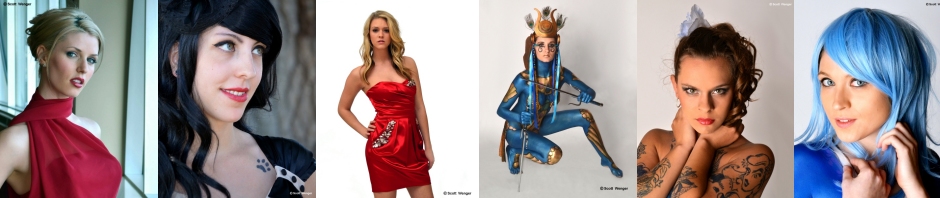
Tips for Models
I've worked with many aspiring models and I have the following tips for models. These tips will help you prepare for a photo shoot:
Hair
The main thing about hair is to keep it out of your face. Your face needs to be seen. Hair can be pinned up. Your hair should not be covering your face. If you have a hair style that you like, we can photograph that style. I've been on photo shoots where there are hair stylists who are at the "top of their game." I've also been on shoots where the model has done her own hair and makeup. If your hair is colored, make sure the roots are not showing. The way your hair is styled can reflect your personal style. I've seen hairstyles called "half up-dos" that look very elegant. I've seen (and photographed) many different types of hairstyles.
During some photo shoots, I've used different types of wigs with models I have photographed. A wig can very quickly change a model's entire appearance — giving an entirely new look. A wig can change not only hair color but hair style quickly. A wig cap is used to press down the natural hair. A wig style that I like (and have used) is the "Cindy wig." Another style that I like is the "bob-cut pageboy style" which is very similar to the "Cindy wig."
Nails
For photo shoots, I prefer nicely manicured nails with either clear polish or french tips. The nails will show up in the photos and I think clear polish or french tips are the best. Some women might think french tips are boring. However, I think they are classy and will never go out of style. I've worked with models who have used fake french nails. I think french nails look professional, are classy, and timeless.
Makeup
The purpose of makeup is to enhance natural beauty. I've seen women who don't look like they are wearing any makeup at all. At one photo shoot that I attended, I saw an attractive woman who I thought was wearing no makeup at all. I took a photograph of her. Then, I took the photo to the cosmetics counter at a large department store. I asked the woman at the cosmetics counter if the woman in the photograph was wearing any makeup and the answer she gave was, "yes." According to the expert at the cosmetics counter, the woman in the photo was wearing an ivory foundation, peach-colored blush, gray eye shadow, eye liner, mascara, and neutral lipstick. All of those things combined to produce a completely "natural" look. That experience proved to me that makeup, expertly applied, can produce a completely "natural" look.
I've been told that "full face" makeup includes foundation, powder, eye shadow, eye liner, mascara, blush, lipstick and lip gloss. A professional model listed the following steps in applying makeup (in the order applied): eye liner, mascara on top eye lashes, face powder, bronzer-blush, mascara on bottom eye lashes, lip stain, lipstick, eye shadow, and eye liner.
I'm certainly no expert on makeup but I've worked with expert makeup artists. Good MUAs (makeup artists) know what colors are flattering, how much makeup to apply, and how to apply the makeup so that it looks beautiful and natural. I've also worked with women who do their own makeup and look great. So, each shoot is different. Makeup can accentuate your best features and hide less favorable features. No one is perfect. For some photo shoots, a makeup artist will be present. For other shoots, you will be expected to do your own makeup. This is something you must learn prior to the photo shoot.
Clothes
It's perfectly okay to wear jeans (or shorts) to go to a photo shoot. However, if you do that, it will be necessary to change into the clothes that you will wear when you are photographed. For the best photos, I think women should be dressed nicely (dresses or skirts, and heels.) Since the process of setting up a shoot usually involves a fair amount of work (setting up lights, stands, backdrops, reflectors, etc), there's no point in photographing someone wearing jeans and a T-shirt. Having good clothes (that fit well) are one of the ways to get beautiful photographs. Clothes should show off a woman's figure. Over-sized or baggy clothes do not photograph well. Clothes should be more tight-fitting.
The photo shoots that I've done have varied widely. On some photo shoots, women bring the clothes they want to wear when photographed (such as a dress or evening gown.) I've witnessed remarkable transformations. For example, one woman went to the photo shoot wearing jeans and a leather jacket. However, once she got to the shoot, she changed into a beautiful evening gown. On other photo shoots, I've brought clothing (or costumes) and shoes for the model to wear.
The clothes can make (or break) a shoot. If a photographer (or client) brings clothes for you that are a little too large for you, the clothes can be pinned in the back (with simple clothes pins.) Sometimes new clothes and/or shoes can be purchased just for the shoot and then returned for a full refund after the photo shoot. If you have clothes that you want to bring to a photo shoot, bring a variety of different things. Just as you want different types of photographs in your portfolio (head shots, 3/4-length shots and full-length shots), you'll want to have a variety of different things to wear. If you have fitness / exercise / workout wear, you can bring that. If you have a favorite bikini and want a bikini photo in your portfolio, you can bring that. A complete portfolio consists of several different looks. Bring a few nice tops for headshots.
Shoes
It's been said that "a pair of black pumps goes with everything." I think a model should have at least one pair of black high heels that she can bring to a photo shoot. Neutral-colored heels are also good. It is not okay to wear sneakers for a photo shoot.
Jewelry
I've taken photos at various beauty contests and I've noticed that some jewelry really makes a difference in a photo. For example, long and wide, shiny earrings (sometimes called "chandelier earrings") can make a positive impact in a photo. They catch the light and add a little "magic" to the photograph. Just look at some contest winners and see for yourself.
Posing
I've worked with models who are very experienced and I've worked with models who have no experience at all. Regardless of the model's level of experience, I always try to get the best angles and lighting. It's much more fun for me when I'm working with an experienced model because she knows how to pose and doesn't need any direction. I've worked with experienced models who immediately get into another pose as soon as the flash unit fires and I've worked with completely inexperienced models who need lots of direction in order to get the first photograph. I can work with both inexperienced models and experienced models but it's much easier to get good photos in a short time with experienced models.
A model's face and her figure are the most important factors in booking. I'd like to add that a positive attitude is a definite plus, also.
Runway models are usually at least 5 feet 7 inches tall. With models who are shorter than 5 feet 7 inches, there are photographic techniques that can make a woman look taller. My tip for runway models is to make sure to pause at the end of the runway for the photographers rather than spinning around quickly at the end of the runway and walking back.
Being on Time
It's much better to show up 10 minutes early to a photo shoot than to show up 10 minutes late. There are costs involved for the photographer and any delays cost money. Any photographer would be pleased if you showed up 10 minutes early to a photo shoot.
It's important to communicate with the photographer before the photo shoot. Things you need to know are the exact address of the photo shoot and the time the photo shoot is to begin. If the shoot involves a certain type of clothes, make a note of that. Write those things down. Find out if a makeup artist will be present at the shoot. Call to confirm your photo shoot. Also, do not call last minute to cancel a photo shoot. If you are a "no show" or are late for a photo shoot, it will definitely harm your reputation as a model.
When you are booked for a photo shoot, communication is very important. You want to make sure the photographer has your contact information (phone number, email address, etc.) You need to understand the type of shoot — whether TFI (time for images) or TFP (time for prints) shoot, the money you'll be expected to pay, or the compensation you will receive. All of this is worked out in advance of the shoot.
I schedule shoots in either one or two-hour time slots. I require a signed model release. My rates are negotiable.
Portfolio
You want to place the very best photos in your portfolio. A portfolio could consist of 6 to 12 photographs. You'll want to update your portfolio from time to time. You can remove photos from your portfolio when you have better photographs to add. Agencies want to see "head shots" (head & shoulder shots), and full-length shots. Your portfolio can have a vinyl or leatherette cover. Some portfolios consist of 8×10 prints (a common size) while other portfolios consist of 9×12 photos.
When building a portfolio, quality is better than quantity.
I think there are four elements in a great photo:
- 1.A good model (with nice hair and makeup)
- 2.Good clothing
- 3.Good lighting
- 4.A good pose and expression
If you've read this far, you are serious about becoming a model.
Good luck to you!!!
Note: If you're an aspiring model and want to learn much more about modeling, there's a book called "The Self-Made Model – Success Without Agencies" by author Christie Gabriel. She discusses her career as a model and she gives lots of useful information for other models. Her book is available from amazon.com ISBN13: 978-0985038908
All images © Scott Wenger. All rights reserved.